

Home › Forum › Ask A Member › 9.5 hp 1966 mdl 9622a lower gearcase
- This topic has 24 replies, 11 voices, and was last updated 9 years, 3 months ago by
 seakaye12.
-
AuthorPosts
-
December 8, 2016 at 8:34 pm #48879
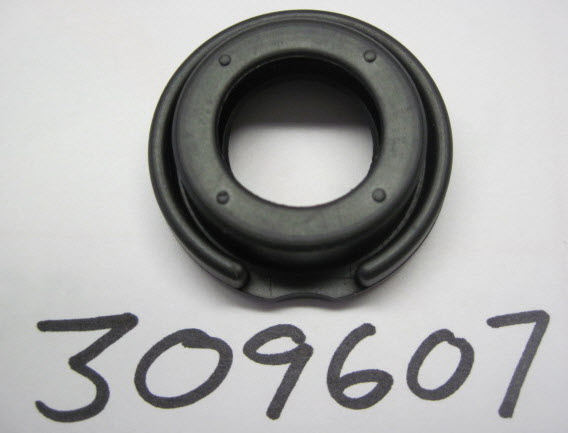
Gentlemen my concern is about the pump’s rubber seal for the DRIVE shaft … the rubber seal sits squarely on top of the water pump and on my 9622a the rubber I.D. does not rub against the drive shaft …..it is about 1.5 times as wide as the drive shaft itself
so the question here is…. is the grommet/seal intended to only buckle (seal) up against the dow tube in which the drive shaft spins or is it intended to actually seal of any water from shooting up in the "down tube" along the drive shaft itself ??
thanks
Joining AOMCI has priviledges 🙂
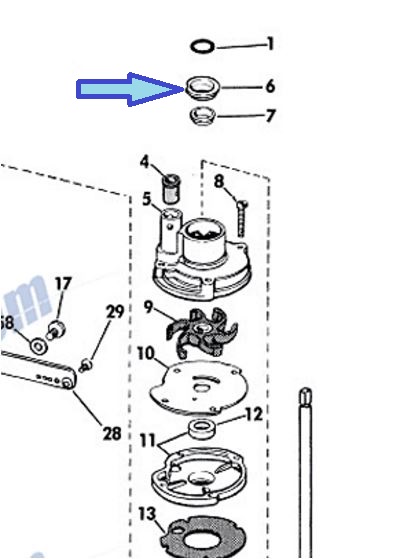
December 8, 2016 at 10:33 pm #48884This is the part you mean, #6 or P/N 309607 on ME’s diagram. No. it doesn’t ride on the shaft, it fits on top of the pump housing and I’m sure the outer O ring shaped part of it makes the seal with the exhaust housing. I don’t have a 9.5 exhaust housing handy to verify that but some other models use just a large O ring. The inner floppy part is like a dam to help keep water inside the finned area of the pump housing. The fins in pump housings help to keep water from sloshing out of the pumps well because the impeller will suck air into the system if it gets dry in there. Right below the water tubes rubber grommet is a small hole which feeds water to this area. When replacing the grommet, make sure this drilled hole is clear to help prevent the motor from running hot.
Attachments:
 December 9, 2016 at 1:07 am #48896quote Theodore:I don’t know that it’s happened here, but it seems that the 9.5 is the engine most likely to have its driveshaft rusted into its crank. Why does it happen, and what can be done to prevent it?
Seems that I have read here that it is (or might be) because of how low the powerhead is to the water. Makes some sense I guess. Preventing it would include seeing that the o-ring is there and in good shape….and that the splines are greased in their grooves (not on top). Bi-annual waterpump service should include this step. Motors that receive frequent maintenance probably won’t have an issue. Lets hope 🙂
I just got finished dealing with the same issue on one of my newly acquired 9.5’s…..
I ended up seperating the exhaust housing from the powerhead and in the quarter of an inch gap there I managed to insert a pry bar and apply enough force that the driveshaft pulled through the water pump. Lost a water-pump housing but then at least the entire driveshaft was available. I attached a pair of vice-grips mid-way up the shaft (protected a bit by a rag) and started tapping.
Of course; to do that you have to first seperate the lower cowls and remove the powerhead-exhaust housing as an assembly. People talk about how hard that is. It’s a bit involved…..but not all that bad actually.
She freed-up 🙂
December 9, 2016 at 2:38 pm #48920ever try to turn the motor upside down and drip some loose-nut or PB Blaster along the drive shaft for a few days to let it soak in… assuming it would bypass the "o" ring of course …?
Joining AOMCI has priviledges 🙂
December 9, 2016 at 3:46 pm #48922quote crosbyman:ever try to turn the motor upside down and drip some loose-nut or PB Blaster along the drive shaft for a few days to let it soak in… assuming it would bypass the “o” ring of course …?I did try that on this 9.5. I have tried it in the past as well….never with good success. After two weeks of hanging upside down, squirting PB, and various shaking and tapping manuevers…I decided to try something more aggressive.
When I finally got it apart…the PB Blaster had never actually gotten into the splines area. Everywhere else but…..
I get a lot of salt water engines out where I am; makes life miserable at times 🙁
-
AuthorPosts


- You must be logged in to reply to this topic.