

Home › Forum › Ask A Member › Lauson T651 Breather Assembly
- This topic has 14 replies, 6 voices, and was last updated 3 years, 8 months ago by
 Tubs.
Tubs.
-
AuthorPosts
-
July 24, 2022 at 8:18 pm #263554
This four cycle Lauson has my brain striving for more good brain cells.
The parts diagrams only shows the crankcase breather as an assembly,
and no hint of what’s inside of it.
At first I was just thinking it was a “snorkel” up above the crankcase a ways
so oil wouldn’t blow out the breather hole, so I blew compressed air through
it to check for pluggage. Air came out. Hopefully I didn’t damage it.
Then I got to thinking about the old automobile’s PCV (positive crankcase ventillation)
valves, that were actual a check valve.
When breathing through the small breather hole, air goes both ways, but sounds different
and you can hear a faint click as well.
Perhaps I should have been breathing through the big hole where it bolts on the
crankcase, but it tasted bad enough as it was!Anyone know how the breather is suppose to function, or the proper way to test it,
if it’s even necessary?
If worse comes to worse, there’s an expansion plug staked in a hole in one end, that
I could try to remove for a look see.
As dirty and oily as the engine was, I have to wonder about it!Does the crankcase need to ventilate when the pistons are going “Up” and
well as down? Perhaps the breather is designed for different flow rates depending
on which was the pistons are going, i.e., breaking vacuum in the crankcase
probably wouldn’t need as much flow through the valve as expelling the
air in the crankcase when the pistons are going down?
Okay, brain needs a break!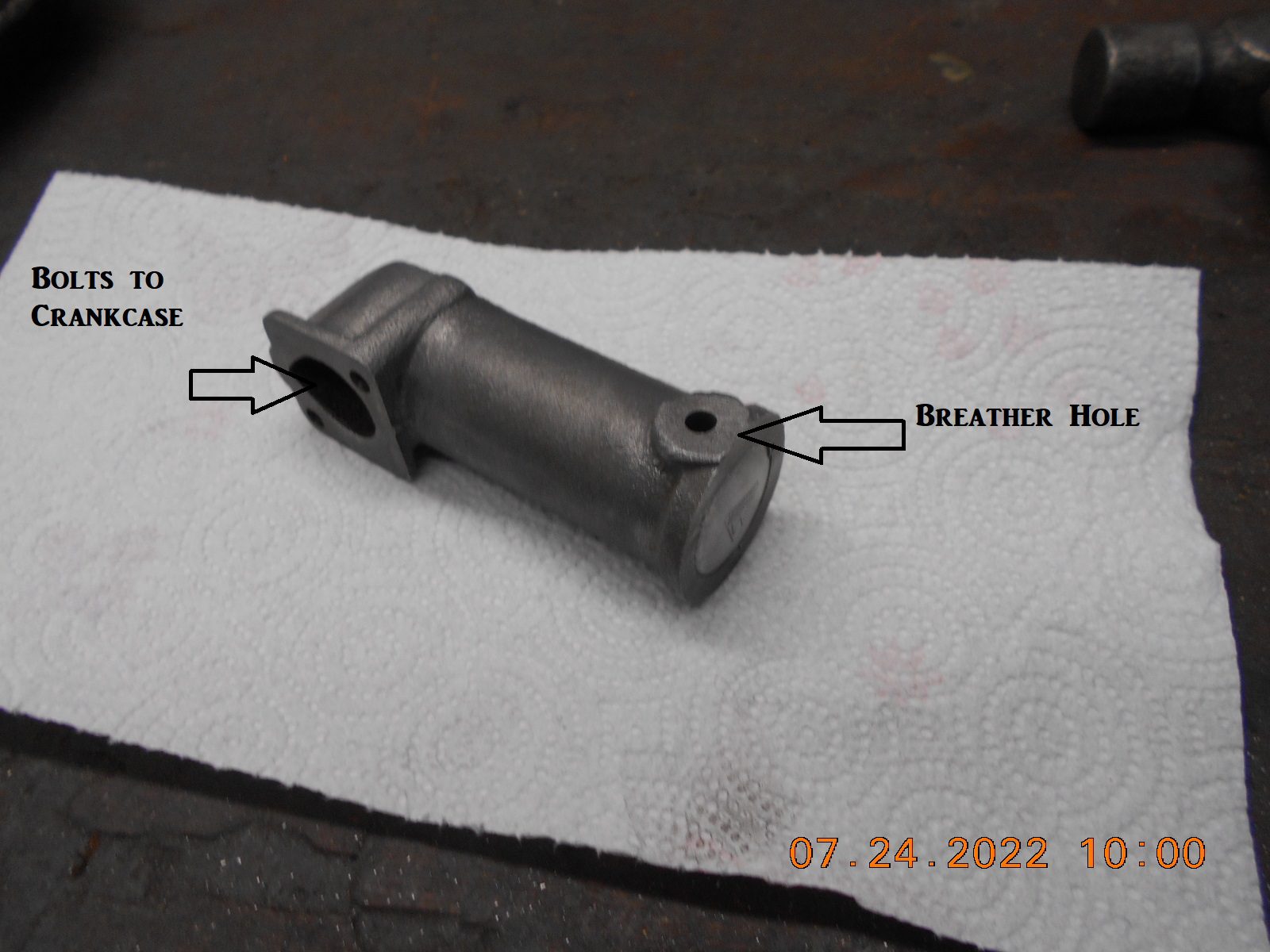
Prepare to be boarded!
July 25, 2022 at 9:02 am #263567Thinking back to my old lawn mower days now. Any engine will have some piston /rings blowby when running. That blowby would pressurize the crankcase if not allowed to escape, causing, among other things, seal leakage and sludge formation. The simple breathers used on mower engines is just a check valve disk which opens with pressure and slaps shut with partial vacuum. I guess the shut phase does allow some bypass.
Of course, all that is illegal with modern engines where vapers are no allowed the escape to the atmosphere, but are re-routed back to the intake manifold for burning.
July 25, 2022 at 9:05 am #263568Thanks Frank. I’ll try breathing through the crankcase end of the breather for fun this morning,
but I’ll have a cup of coffee handy for a chaser!Prepare to be boarded!
July 25, 2022 at 10:36 pm #263601Bucc, my guess is that there are a series of sheet metal baffles under that cap. Kind of a zig -zag labyrinth to retard the progression of oil droplets/ vapor from blowing out the vent hole. Exactly the same set-up as on a Model A Ford oil fill/ vent tube.
Joe B
July 25, 2022 at 11:21 pm #263603Joe, it sounds like there’s a disc or something moving inside
when you breath through either end. When, or If I get it running,
I’ll try to look and see if it’s blowing oil about.
It seems like a lot of old push mower engines just had an elbow
with a short hose on the valve cover, no check valve of any kind,
for the breather.Prepare to be boarded!
July 26, 2022 at 12:30 am #263604Older car engines just used a tube to exhaust the gases from the crank case.It was called a road draft tube.
July 26, 2022 at 5:36 am #263605Buc, you are usually a guy after my own heart, diving in deep, deep, where nobody else would usually go. Now you have us all on the edge of our seat. You have just GOT to drill out that welsh plug and see what’s in there!
Long live American manufacturing!
July 26, 2022 at 8:32 am #263610Older car engines just used a tube to exhaust the gases from the crank case.It was called a road draft tube.
Pretty sure my 56 Studebaker Champion, with a flathead six, had a draft tube.
I forgot about that high tech!Prepare to be boarded!
July 26, 2022 at 8:35 am #263611Buc, you are usually a guy after my own heart, diving in deep, deep, where nobody else would usually go. Now you have us all on the edge of our seat. You have just GOT to drill out that welsh plug and see what’s in there!
Bill, I’m going to look for one better cylinder head off the parts engine,
so maybe I’ll nab the breather off it at the same time and do some
“inspection”, lol.Prepare to be boarded!
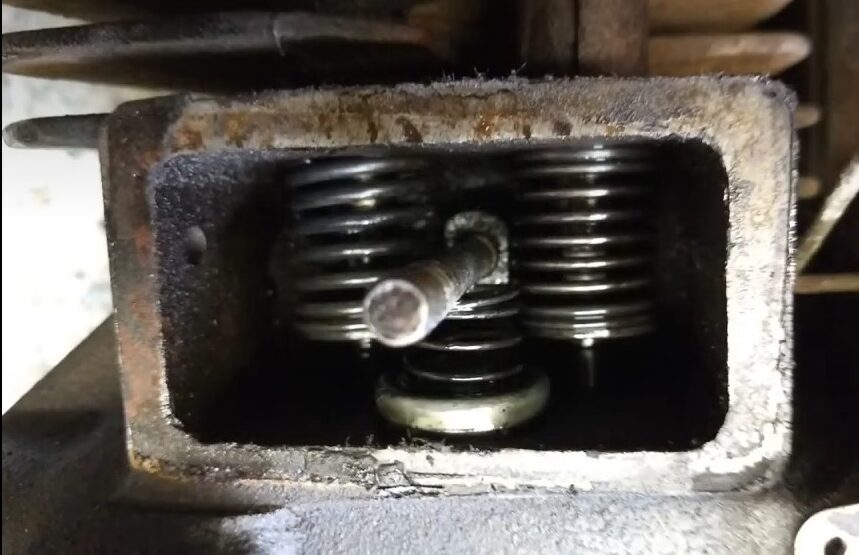
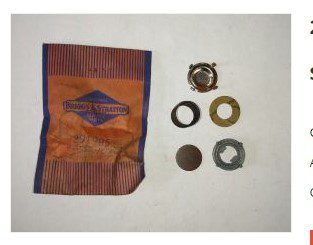
July 26, 2022 at 1:59 pm #263636Valve chamber on a B & S Model N, like the first engine I ever worked on, in 1954. Breather is the device held down by a spring under the stud. It basically is just a disk in a cage.
-
AuthorPosts


- You must be logged in to reply to this topic.