

Home › Forum › Ask A Member › Electric Start Test Station
- This topic has 8 replies, 4 voices, and was last updated 8 years, 2 months ago by
 Buccaneer.
-
AuthorPosts
-
June 29, 2018 at 12:07 am #10400
While I have no boat with remote controls, I do have a couple
of motors with electric start. I’m going to try to make a
test station / junction box I can hook up to whatever OMC
motor and a 12 volt battery. I have a 12v OMC style starter solenoid
on order, as well as a ballast resistor and push button switches for
"start and choke". I have an old, but somewhat small, electrical
disconnect box that I gutted. and will try to see if it all fits
inside.
Has anyone made their own junction box for testing purposes,
and if so, have photos? I’ve been studying 12v conversion diagrams, etc.,
that I’ve found on site.
I’d like to be able to use it on 6 or 12 volt systems.
Also, the mercury switch on one motor has no wire connected
to it. I tested the switch itself with a VOM and it seems okay.
How were the wires attached? Can I solder one on the switch,
or am I going to have to call the Hazmat team after mercury
blows all over? 😮
Thanks.Prepare to be boarded!
June 29, 2018 at 12:38 am #78642I had a cobbled-up affair in the workbench next to the test tank, but that was long ago and don’t remember the details.
Anyhoo, the pin on the mercury switch is stainless steel and not solderable. The original wire was somehow welded to it.
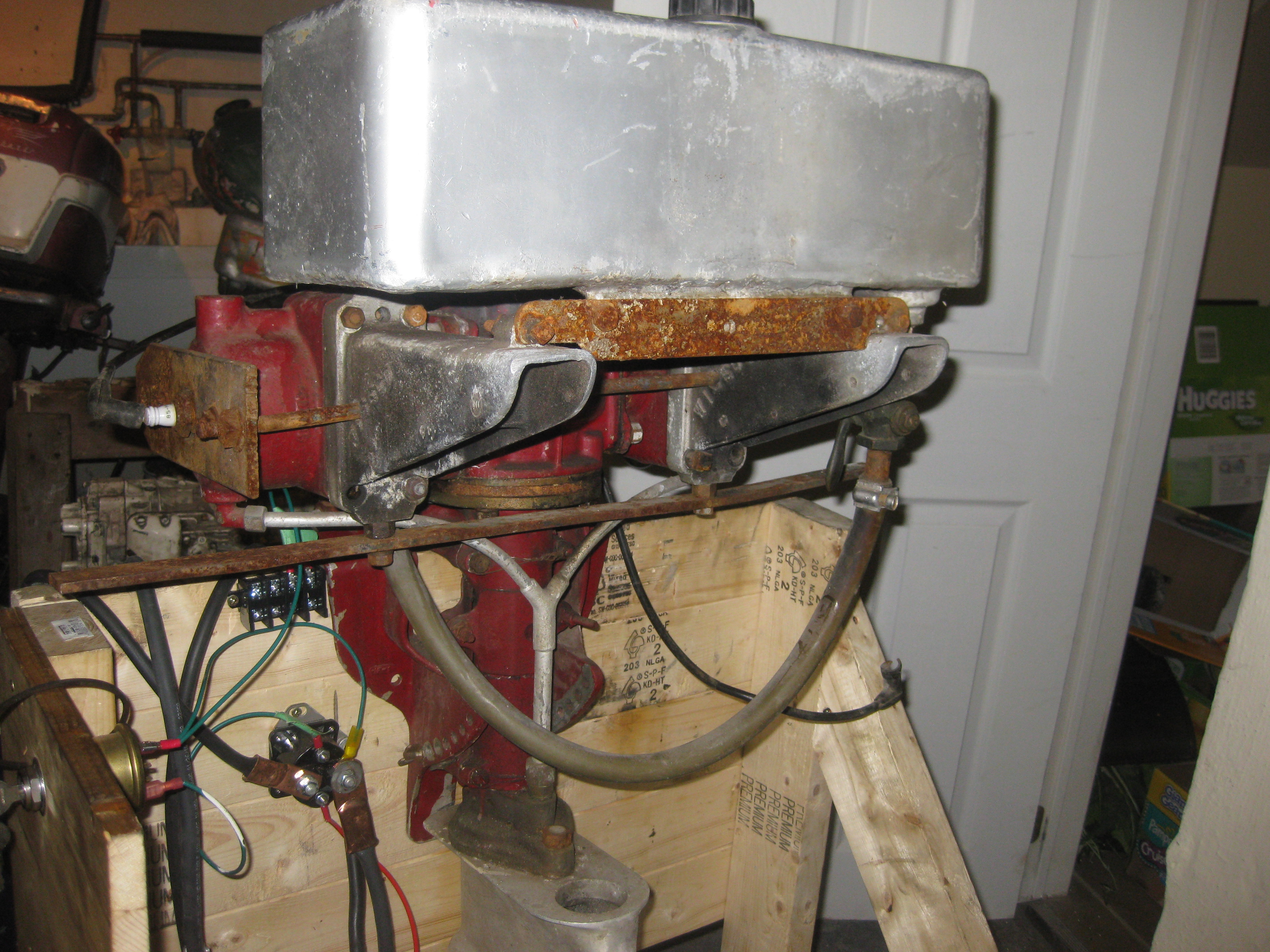
June 29, 2018 at 1:06 am #78643I have them all a bunch of my stands, at the test tank, etc..
Here is a quick one on a stand. Only picture I can find.
Attachments:
 June 29, 2018 at 2:41 am #78648quote FrankR:I had a cobbled-up affair in the workbench next to the test tank, but that was long ago and don’t remember the details.
Anyhoo, the pin on the mercury switch is stainless steel and not solderable. The original wire was somehow welded to it.
I wonder if the wire could be clamped / crimped onto the mercury switch pin
with a lead fishing sinker or other means?Prepare to be boarded!
June 29, 2018 at 2:44 am #78649quote Chris_P:I have them all a bunch of my stands, at the test tank, etc..Here is a quick one on a stand. Only picture I can find.
Chris, thanks for the photo. I like your set up….. reminds me
a little of Frankenstein’s Laboratory! I hope to make mine
a little more portable, and not permanent on a particular stand.Prepare to be boarded!
June 29, 2018 at 2:59 am #78650That wire on the mercury switch may be on there with a small spot-weld. Gee – I never paid attention – now I’m curious and am gonna hafta take a look at one tomorrow.
You may be able to use conductive epoxy – heating it with a soldering iron doesn’t sound like a good thing to do given how mercury expands..
https://www.amazon.com/Adhesive-Electrically-Conductive-Bonding-AA-DUCT/dp/B00EPYCDPW/ref=sr_1_1_sspa?ie=UTF8&qid=1530241038&sr=8-1-spons&keywords=conductive+epoxy&psc=1&smid=A1665ONA14XMDLI wish OMC had standardized on the connector plug and left it that way for a lot of years – I’ve been putting a jumper cable right on the starter motor terminal. I have one boat wired two different ways – one is the 1957-1960 side plug and the other has a harness I have to connect all the ends to when i run my 40 HP Lark III. I’m wondering if they discontinued the side plug because if you remove the plug, you can rope start without the ignition key?
DaveJune 29, 2018 at 3:15 am #78652quote outbdnut2:That wire on the mercury switch may be on there with a small spot-weld. Gee – I never paid attention – now I’m curious and am gonna hafta take a look at one tomorrow.You may be able to use conductive epoxy – heating it with a soldering iron doesn’t sound like a good thing to do given how mercury expands..
https://www.amazon.com/Adhesive-Electrically-Conductive-Bonding-AA-DUCT/dp/B00EPYCDPW/ref=sr_1_1_sspa?ie=UTF8&qid=1530241038&sr=8-1-spons&keywords=conductive+epoxy&psc=1&smid=A1665ONA14XMDLThanks, Interesting idea with that conductive glue. Only one review though, and
guy said "It didn’t work, didn’t get hard after 14 hours!"Prepare to be boarded!
June 29, 2018 at 3:51 pm #78671quote Buccaneer:Thanks, Interesting idea with that conductive glue. Only one review though, and
guy said “It didn’t work, didn’t get hard after 14 hours!”Hmmmm – we used to use conductive epoxy at work on prototype implantable medical products where we couldn’t use lead solder or flux and it worked well – Not sure what brand we used. I remember it was a 2-part epoxy mix – probably more like this one than the one part link Iposted earlier:
June 29, 2018 at 7:18 pm #78683This one sounds a little more promising.
Hmmmm – we used to use conductive epoxy at work on prototype implantable medical products where we couldn’t use lead solder or flux and it worked well – Not sure what brand we used. I remember it was a 2-part epoxy mix – probably more like this one than the one part link Iposted earlier:
Prepare to be boarded!
-
AuthorPosts


- You must be logged in to reply to this topic.