

Home › Forum › Ask A Member › Will these Capacitors Work?
- This topic has 27 replies, 12 voices, and was last updated 4 years, 6 months ago by
 labrador-guy.
-
AuthorPosts
-
July 21, 2021 at 8:59 pm #243426
…just thinking if some fuel or other gets on the silicone might deteriorate. Poly glue is harder and usually fuel resistant.
August 29, 2021 at 10:21 am #245678Tom, You seem to grasp these condenser issues pretty well. Could you help me understand why a failed condenser affects performance. I’ve read and re read W. Mohat’s excellent magazine articles about condensers and magneto technology. I think I understand how the condenser protects the points from arcing by absorbing a bit of the peak energy from the primary coil (current/voltage). But is the poor performance associated with condenser failure ONLY a function of damaged points or does the condenser affect performance in some other way? In these older engine schematics the condenser isn’t even part of the secondary winding circuit. A failed condenser would be unable to moderate the primary coil voltage resulting in a higher PRIMARY voltage spike which, if anything, should result in an even higher voltage spike from the secondary coil. Of course that higher voltage spike would be aborted as soon as ignition took place, but hypothetically would be advantageous (except for arcing to and burning the points). What am I missing?
August 29, 2021 at 10:50 am #245680Bucc, there is a physically smaller size of these .22mf caps. they are 7/16 diam X 1-3/16 long. they have a slightly lower voltage rating of 850V . We have used these in many motors with good results
I believe that the 850V rating is more that adequate for our magneto service.
#1839HQ – 220nfJoe .
August 29, 2021 at 11:10 am #245683The condenser is there to prevent arcing and release charge to the coil primary to generate a spark.
The way I understand it, outboard condensers can fail two ways. If they short out or leak, the affect is the same as if the points never opened. If they fail open (not likely) it’s as if there is no condenser. Leakage needs to be tested at a significant voltage; I test at 200V or higher. If a condenser leaks, it won’t hold a charge and/or it won’t charge and discharge properly. The condenser needs to charge and discharge quickly to result in a proper spark. The most prominent fallacy I run across is that the capacitance and voltage are all that matter. One more factor is the charge / discharge rate which is rated in dV/dt, or change in voltage per change in time. Capacitance can be off by 100% and a motor will run. If dV/dt is too low, the other two factors become irrelevant. The discrete components recommended on this site take the dV/dt into account.
The WICO condensers in the brass cans and screw post are notorious for failing. These are used in lots of Scotts and Martins. Testing them with a multimeter NOT indicate a bad one unless it’s shorted.
They need to be tested at a much higher voltage than a multimeter will generate. I’ve seen several cases in which they will give one or two sparks when you flip the flywheel by hand, but that’s all you’ll get. The motor will pop a few times and not run. So the owner checks spark at the plug and sees one nice spark. Then back to roping and frustration. The guts of these units can be replaced with a new component, but I’ve run across some of the cans that cannot be reused. The insulator between the body of the can and the top post conducts enough to render them useless. This is almost universal in those used in a salt water environment.Hope this helps.
T
August 29, 2021 at 1:26 pm #245691Bucc, there is a physically smaller size of these .22mf caps. they are 7/16 diam X 1-3/16 long. they have a slightly lower voltage rating of 850V . We have used these in many motors with good results
I believe that the 850V rating is more that adequate for our magneto service.
#1839HQ – 220nfJoe .
Joe, these are the .22 ones I normally use, perhaps the same thing you cite.
I was out of them, and had those “Big Uns” so thought I’d use them.
===============
.22 UF AxialDigi-Key Part #
BC2609-NDManufacturer Part Number
MKP1839422084HQDescription CAP FILM 0.22UF 5% 850VDC AXIAL
Detailed Description 0.22µF Film Capacitor 400V 850V Polypropylene (PP),
Metallized Axial
================Prepare to be boarded!
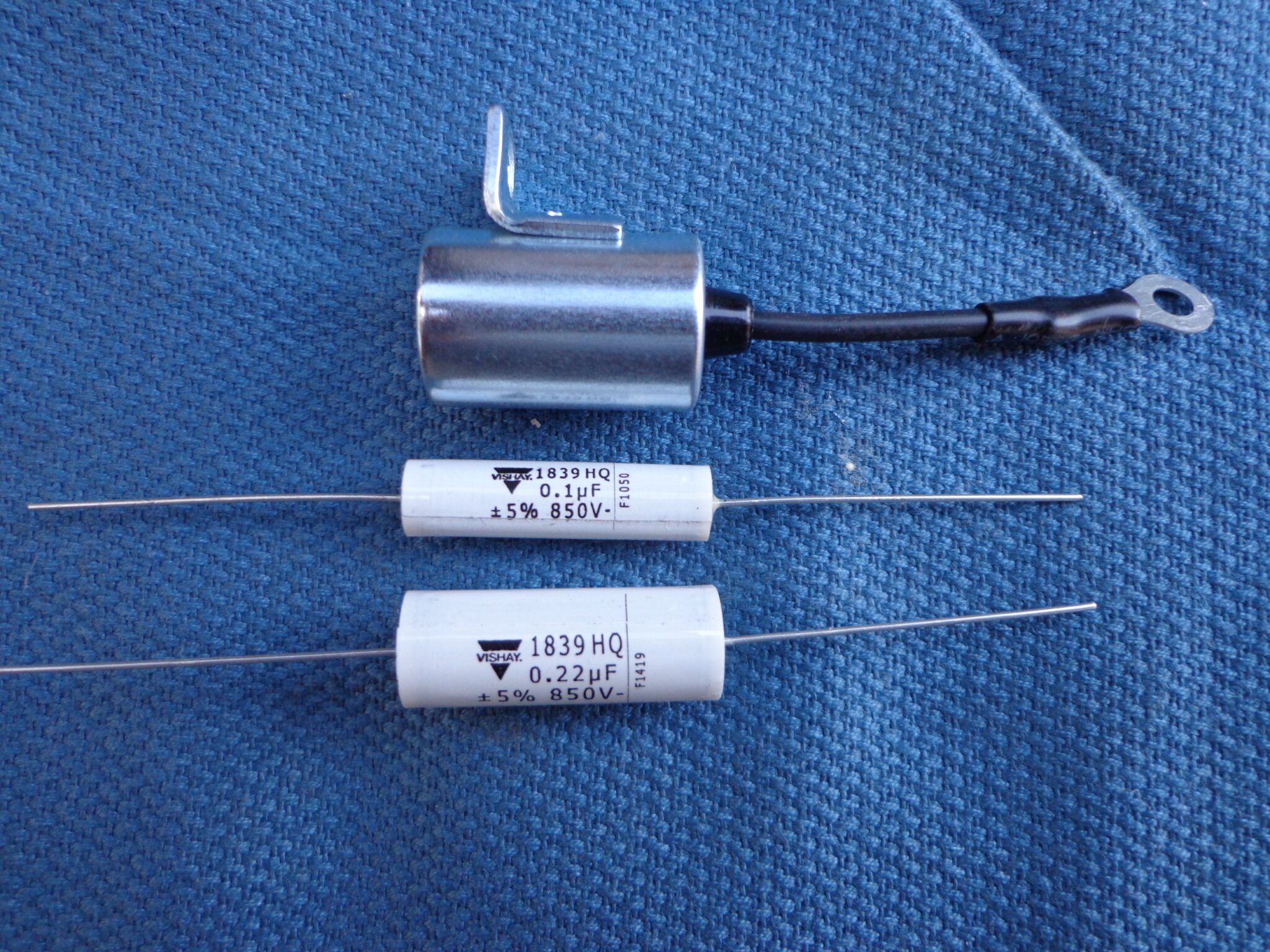
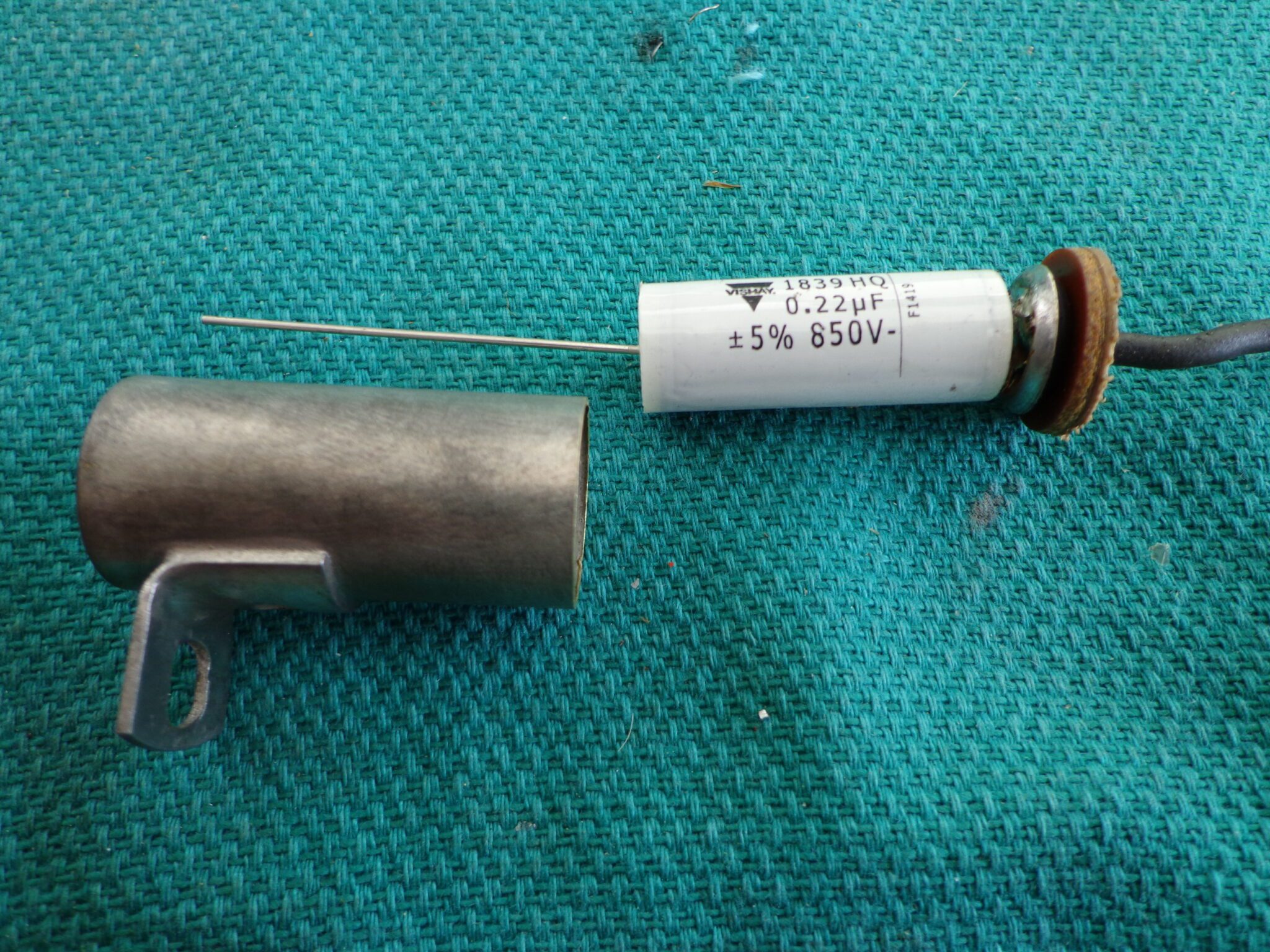
August 29, 2021 at 4:20 pm #2456981839 HQ series 850 V. 0.10 and 0.22 uF caps compared to a 580321 cap.
The 22’s will fit in the taller 581419 can but it’s a tight fit.
 August 29, 2021 at 4:49 pm #245705
Aha! If the condenser shorts or leaks, the current in the primary coil circuit is not interrupted (as if the points had never opened). Hence, no collapse of the primary coil magnetic field, no jump in the primary or secondary voltage and no induction shock. Plus, intermittent or incomplete shorting allows for erratic and unpredictable performance. Makes perfect sense. Thank you.
August 29, 2021 at 9:47 pm #245747Aha! If the condenser shorts or leaks, the current in the primary coil circuit is not interrupted (as if the points had never opened). Hence, no collapse of the primary coil magnetic field, no jump in the primary or secondary voltage and no induction shock. Plus, intermittent or incomplete shorting allows for erratic and unpredictable performance. Makes perfect sense. Thank you.
EXACTLY!!
dale
-
AuthorPosts


- You must be logged in to reply to this topic.