

Home › Forum › Ask A Member › Water Witch
- This topic has 10 replies, 3 voices, and was last updated 4 months, 2 weeks ago by
Sam M..
-
AuthorPosts
-
April 21, 2026 at 10:09 pm #316113
I may need a little help installing the magneto on my 1939 Water Witch, Model No. 571.11. Specifically, the set screw position and the timing marks.
I have mated the timing marks on upper magneto gear and the lower advance gear – but I am not sure all is well.
There is a notch in the crank shaft case which I assume is the home for the set screw on the magneto – correct?
The magneto also has a second screw that compresses the collar around the crank shaft case. But if I tighten this screw, then the magneto cannot move when the control knob is turned.
What am I missing here?
New member here. Any thoughts will be appreciated.
Thanks.
Stephen
April 21, 2026 at 10:53 pm #316118
The screw that compresses the collar around the crankshaft case is a friction adjustment. You only want it tight enough that the magneto plate wont be moving when the motor is running. The notch in the gear drive shaft is for the set screw of the timing lever. You should position the gear on the magneto plate so its in the center of its movement with the timing lever pointing to 12 O’clock. You can decide if there needs to be a correction after you have the motor running.
A "Boathouse Repair" is one thats done without having tools or the skills to do it properly.
1 user thanked author for this post.
April 21, 2026 at 11:14 pm #316119Just what I needed to know. I’m learning as I go. Thanks so much for your help.
April 21, 2026 at 11:55 pm #316122I now understand the screw on the magneto collar that compresses the collar around the crankshaft case – just make it tight enough to stabilize the magneto while the crankshaft spins.
But there is a second screw (a set screw) on the magneto collar. I’m not clear on where to position the magneto before tightening this set screw. I assumed that this set screw is seated in a small notch in the crankshaft case – which tells me the right position for the magneto. Correct? This is where I am a bit confused.
Assuming the gear drive shaft you referred to is the shaft with the advance lever knob at one end, I think I understand your point. Position the advance lever knob pointing up at 12 o’clock with the timing marks on both the upper and lower gears mated. Correct? The advance lever knob on my motor has two set screws.
Thanks again for your help.
If I need to send a few pictures to make my questions more clear, please let me know.
April 22, 2026 at 10:46 am #316155
I still have one of these that I display from time to time, but it has to be 30 years or more that I have messed with it. As I cant remember what I had for dinner last night, I’ll see if I can take a look at mine today to get a better understanding of what you’re asking. As a newbie knowing the basics of how these run can be helpful in understand the purpose of something without overthinking it. First the fuel system. While a carburetor will have float bowls, jets, power valves, metering rods, accelerator pumps, choke and throttle plates, and such the early motors have none of this. Its what’s often called a fuel mixer. Your Waterwitch has the most basic fuel mixer. Not even a float bowl to help regulate the fuel mixture as the fuel runs down in the tank. The “poppet valve” inside the mixer is pulled open by suction as the piston is going down. Fuel is added to the air as it passes over a hole in the valve seat under the valve. How much fuel is mixed with the air is controlled by the mixture screw. That’s it. Dirt is about the only issue you can have, however the needle can often be severely rust pitted on these. There is no throttle plate to regulate the amount of air. Compared to a carburetor, a fuel mixer is wide open all the time. The speed of the motor is controlled totally by when the sparkplug fires in relation to the location of the piston in the cylinder. The closer the piston is to the top of the cylinder when the fuel ignites, regulates the speed of the motor. The “Timing” of the spark, to ignite the fuel, is adjusted by moving the magneto plate. As the motor turns clockwise, moving the magneto plate counterclockwise makes the spark occur sooner, making the motor spin faster. Most of the early motors just have a lever mounted to the magneto plate, you move by hand, to adjust the timing. You have some gears, a shaft and a lever to do this instead. If it is out of adjustment, the only thing that is affected is which way the lever ends up pointing, not aligning with slow, start, or fast. Knowing this, I believe you can make sense of what you have (self-taught) but I do intend to take a took at my motor – if I remember. I’m sure you know much of this already but I need to include it all for any of it to make some sense.
A "Boathouse Repair" is one thats done without having tools or the skills to do it properly.
1 user thanked author for this post.
April 22, 2026 at 3:27 pm #316181Thank you so much for your time and interest. I really appreciate both.
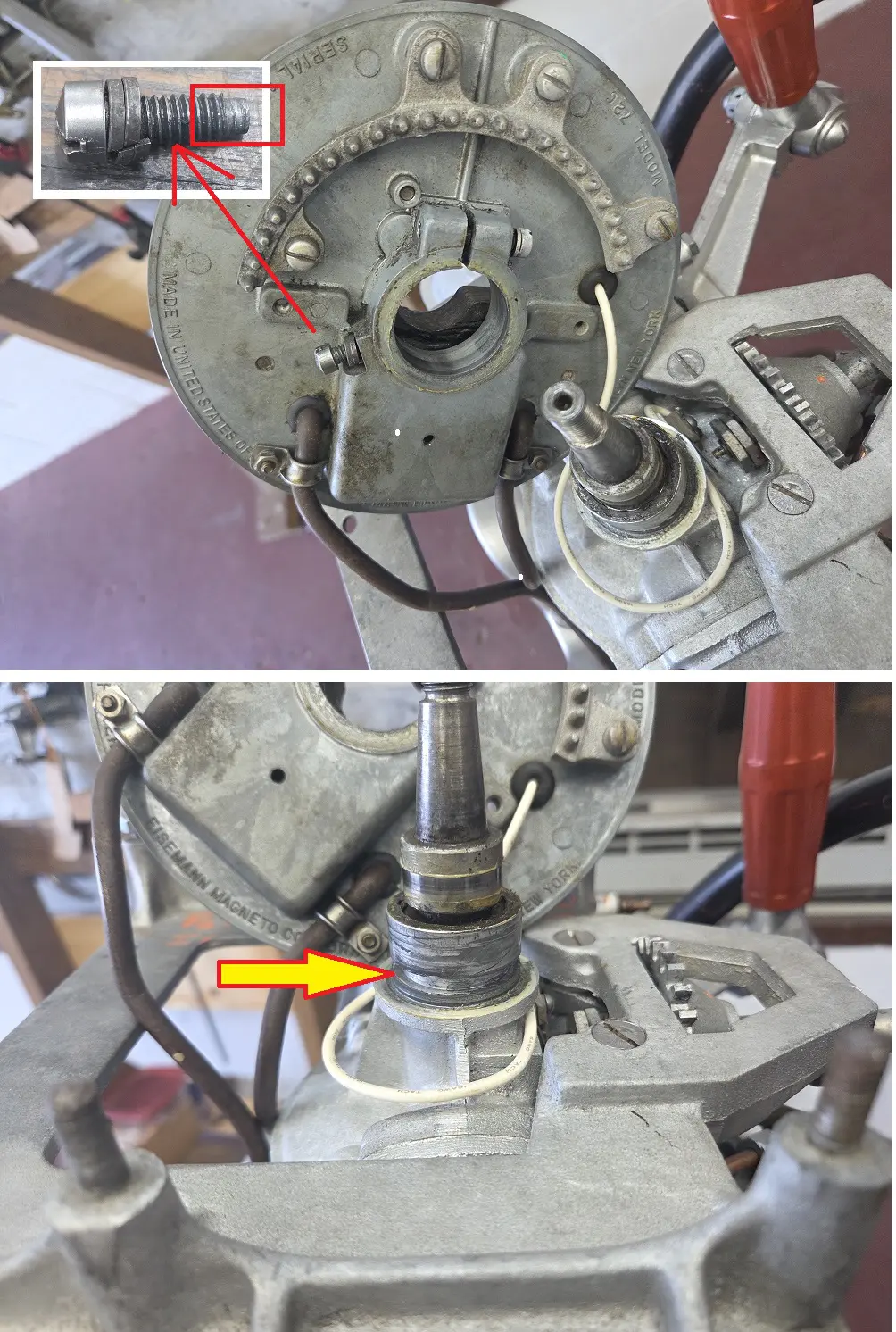
April 22, 2026 at 7:03 pm #316196The other screw, if it hasn’t been lost, should look like this. The end is meant to be in the grove on the main bearing to keep the magneto plate from lifting. Notice how mine has two lock washers to keep it from going in too far, and locking up the magneto plate, but still in far enough that magneto plate it can’t move up.
A "Boathouse Repair" is one thats done without having tools or the skills to do it properly.
April 24, 2026 at 12:04 pm #316332Thanks so much for your follow up.
My motor as pictured looks just like yours. I have installed the magneto and put what looks like a set screw into the notch on the crankshaft collar.
I also put some tension on the screw that compresses the collar – but not enough to bind it. Hard to believe this screw remains in the same position after the engine has been running.
All appears to be well. I should be doing a test start soon. Any tips on the fuel/oil mix will be welcomed.
Thanks again.
April 24, 2026 at 12:07 pm #316334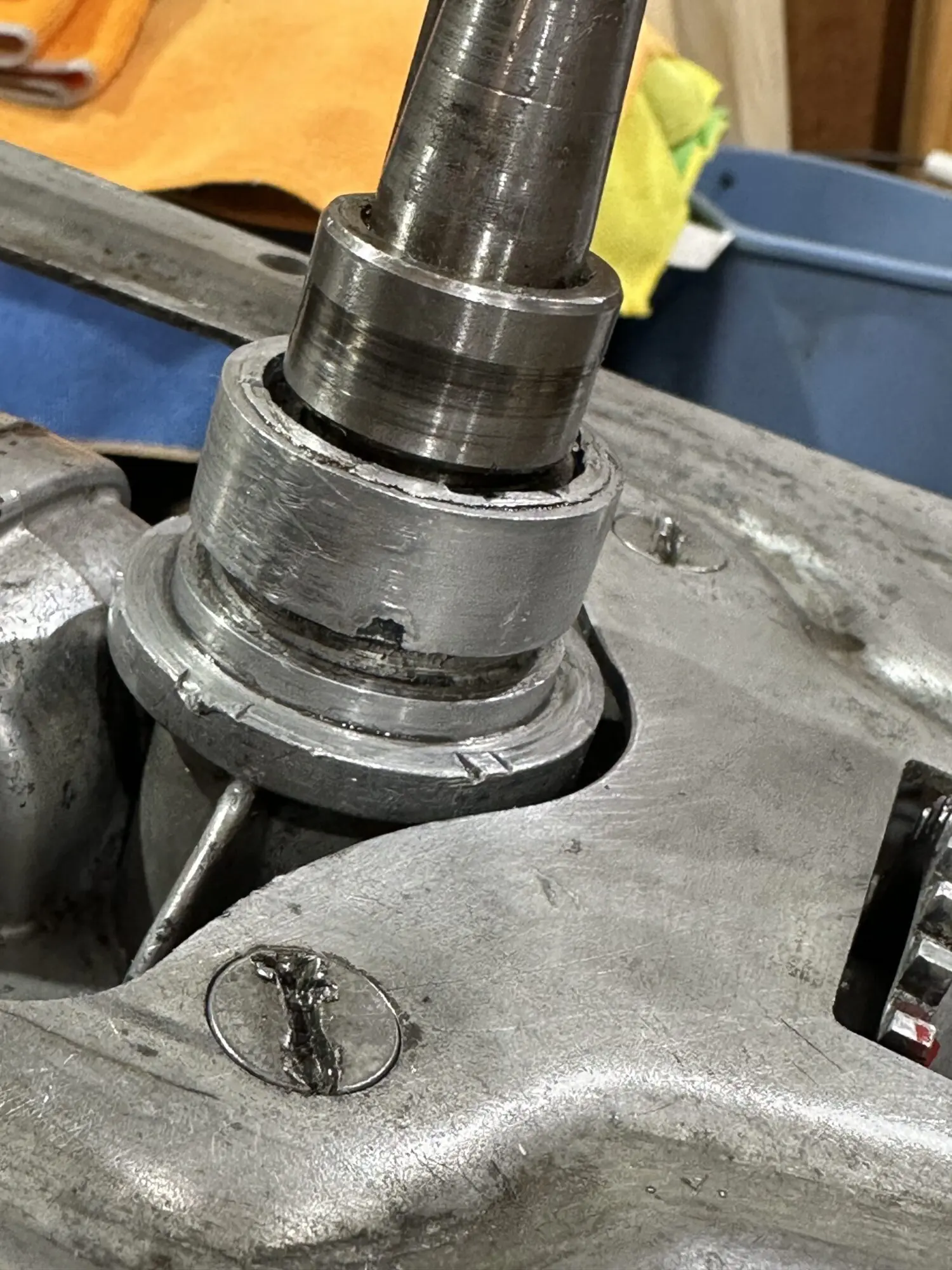
Thanks so much for your follow up.
My motor as pictured looks just like yours. I have installed the magneto and put what looks like a set screw into the notch on the crankshaft collar.
I also put some tension on the screw that compresses the collar – but not enough to bind it. Hard to believe this screw remains in the same position after the engine has been running.
All appears to be well. I should be doing a test start soon. Any tips on the fuel/oil mix will be welcomed.
Thanks again.
April 24, 2026 at 10:46 pm #316388You won’t really know how tight it need to be till its running. These early motor vibrate quite a bit. If the timing is changing it will need to be tightened a little more. Getting it set so the mag plate doesn’t move, but you can still move it, can often take a few tries. Even on motors that just have a lever. You should know that these motors have a bad reputation and they deserve it. While there are some that do run well, most don’t. While mine is real easy to start, it runs like crap. Now when it comes to the oil, I’m not a run a bunch because oil is cheaper than parts guy. I use a biodegradable, full synthetic. When running a motor that hasn’t been used in years, for the first time, I want to use extra oil. I mix up a half gallon with 4 oz of oil. That is 8 oz per gallon. 4 oz. less than the recommended amount that is on the rope pulley of your motor. After I use that up I would run 3 oz. per. gallon. If I find a motor doesn’t run the same it means that there isn’t enough oil to seal the main bearings and air is getting into the crankcase. My motors run from the 20’s to a few in the 60’s. The only motors that I have that need more than 3 oz. are the small motors like the 1/2 hp Cub and Mate, the Pal, Scout, and so on. I run 5 oz. in those motors. This is not a recommendation. Its what I do. I’m just another guy on the internet, offering my experience, for you to consider in deciding the amount of oil you’ll feel comfortable using.
A "Boathouse Repair" is one thats done without having tools or the skills to do it properly.
-
AuthorPosts


- You must be logged in to reply to this topic.